We help parents act, not just read about parenting.
We help parents act, not just read about parenting.
The assistant runs on a knowledge base curated by people with parenting experience — our own write-ups based on trusted parenting books, vetted answers, PDF templates. It doesn't invent advice on its own: it fits those materials to your specific situation. If something is outside its sources, it honestly says “I didn't find it” — instead of making things up.
Who's behind it
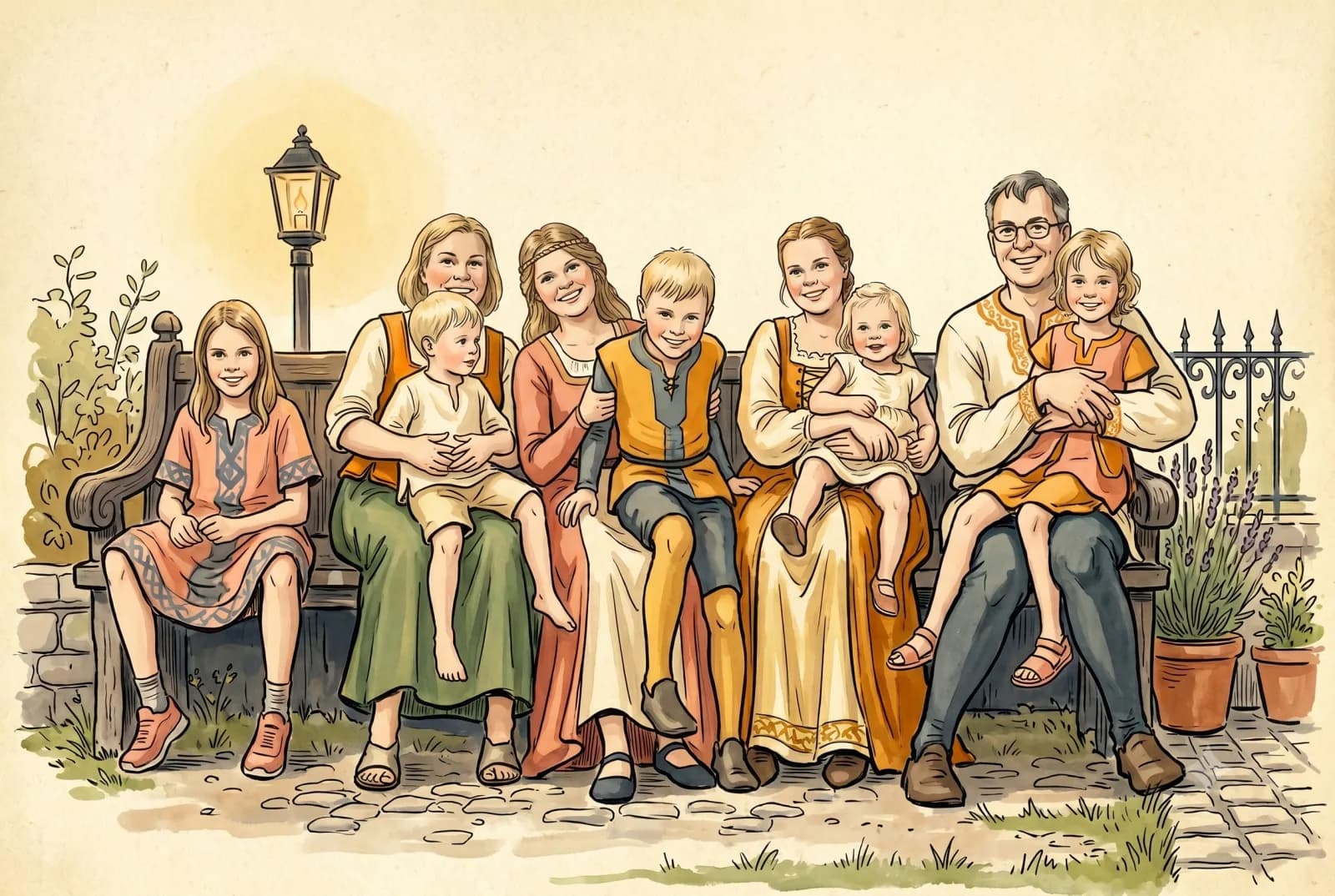
We are a family raising seven children — including children with various forms of neurodiversity. Every day we see in practice that there's no single “universal” recipe for parenting: a strategy that works with one child can be completely ineffective with another.
Mission: Family is our way of turning years of attempts, mistakes, books and conversations with specialists into a tool that genuinely helps with everyday challenges — so that you don't have to grope your way forward the way we did for many years.
Our mission
Most parents today have two sources of parenting knowledge: their own home of origin (often imperfect) and the internet (often contradictory). Books give credible answers, but 300 pages of a parenting guide is a luxury few have time for.
We want every parent — regardless of the home they grew up in — to have at two in the morning access to a trustworthy, concrete, warm answer to whatever is bothering them right now. Without judgement. Without Instagram gurus. Without made-up advice.
The styling is deliberate
Morning plan, screen-time contract, family manifesto — we design every material like a game artefact: with seals, ornaments, room for the child's name. The child has to want to hang it on the fridge; the parent has to see the concrete. The parchment aesthetic ties both together — the adult reads a contract, the child reads a scroll, and it's literally the same document.
We don't pretend to be a game. No points, no levels, no notifications. We just respect the fact that a plan a child treats as part of a shared adventure works better than a plan a child treats as an order.
The assistant doesn't invent advice — it uses vetted material
The assistant does not create advice from scratch. The base it uses — original material based on trusted parenting books, conversation scripts, PDF templates, safety instructions — is developed and verified by people with parenting experience.
The assistant combines those ready, vetted materials and adapts them to your specific situation. If a topic goes beyond what we've prepared, the assistant honestly says “I didn't find it in my sources” — instead of making things up. See the full list of books we draw on →
There's no magic underneath — just source discipline and humans at every step.
Knowledge base curated by experts
Every element of our base — an excerpt of advice, a PDF template, a conversation script — is first developed and approved by people with parenting experience. Only verified materials enter the knowledge base the assistant uses. Without that step, nothing goes live.
Anonymisation before AI
Before your message leaves our server, the child's name is replaced with a technical placeholder. Neither Anthropic (the author of the Claude model) nor any other AI provider will see your child's name or any identifying data. Only in the response you see is the placeholder mapped back to the real name — in the correct grammatical form.
Diagnosis first, advice second
The assistant always asks about context first (1–2 short questions) before proposing a strategy. Because “my 5-year-old won't go to bed” means something quite different for a neurotypical child and for a child with ADHD, and the answer has to be different.
Safety first
If a conversation signals violence, neglect, or threat to life — the assistant immediately stops giving parenting advice and points to helplines (116 111 — Children's Helpline, 800 120 002 — Blue Line, 112). This safeguard cannot be turned off.
A plan for the fridge
Every conversation can be closed with a printable A4 PDF — a morning plan, a screen-time contract, a family manifesto. Because a sheet on the fridge works better than scrolling chat history mid-meltdown.
What you can do here
Chat with the assistant
Pick a challenge (morning chaos, boundaries, screens, emotions, sleep…), tell us about your child in one sentence, get a concrete conversation or strategy proposal — built from materials prepared and approved by people with parenting experience.
Parenting goals
From any conversation you can pull out a short, concrete goal (“Calm mornings without yelling”) and come back to it — Mission: Family remembers the history and helps you check whether it's working.
Printable materials
Morning plan, screen-time contract, family manifesto, reward tracker. Every template is designed and verified by people with parenting experience; the assistant adapts the content to your conversation and gives you a safe PDF link — no installs.
Child profile, not a survey
All you need is an alias (not a surname!), month and year of birth, and optional notes about what's on your mind. You can have several children — each with its own thread.
These are product decisions, not marketing slogans. Baked into the code.
Knowledge base curated and verified by experts
No “internet advice”. Every fragment of our knowledge base and every PDF template is developed and approved by people with parenting experience. The assistant combines those materials — it doesn't create them.
The child's name does not reach the AI
Anonymisation happens on our server, automatically, always. It's a GDPR requirement — and our promise.
We don't train models on your conversations
Your chat is yours. We don't sell data, don't pass it to advertisers, don't use it to train any AI model.
No judgement, no “be a more mindful mum”
The assistant doesn't moralise. It doesn't assume you're doing something wrong. It gives concrete tools — or it honestly says it doesn't have one.
Your data is yours
At any time you can download a full copy of your data or delete your account together with all conversations and child profiles. No questions and no surveys.
Who this is for
For parents who want to parent consciously, not out of habit — and need something more than a motivational Instagram quote.
For the busy who don't have time for a third book on positive discipline, but will gladly spend four minutes on a conversation and print a plan for the fridge.
For young parents who are building their parenting style from scratch — and for parents of neurodivergent children who don't want yet another “universal” guide.
Try it — it costs nothing
Free start, no card, no subscription. Your first plan on the fridge in 5 minutes.